Preparations and packing list
A well-prepared pilgrim is a happy pilgrim! These tips will help you prepare for hiking the pilgrim paths of Norway.

Walk at the right time of the year
The main season for pilgrimage in Norway is between 1st June and 1st September. Routes that go across mountain areas have a shorter season due to snow and snowmelt, while some other sections are accessible and have open accommodations also in the spring and autumn. Learn more in the pages about each of the 9 trails.
You can also check with the regional pilgrim center for the area you plan to walk in, they can tell you what time of year it is recommended to walk, and how the current conditions are. In addition, it's important to check the weather forecast along the way.
Read up
Although it is relativly safe to hike in Norwegian forests and mountains, you should have some knowledge and take some precautions before going on a long hike. Here you can read about safety on the Norwegian pilgrim trails - Including emergency numbers, rules regarding camping and campfires, and advice on how to act when you encounter animals.
The pilgrim paths go through villages, agricultural landscapes, valleys and forests. Some of the paths also pass through demanding mountain terrain. If you are planning to cross mountains, it's important that you learn about the safety principles for travel in the Norwegian mountains. We strongly recommend that you familiarize yourself with the Norwegian Tourist Association's Mountain Code before embarking on your pilgrimage.
Get fit
On a pilgrimage you usually walk about twenty kilometres a day, several days in a row. A good advice is to go for long walks well in advance of the pilgrimage. Then you get a chance to get familiar with the hiking shoes and the weight of your backpack, and you'll probably get in better shape. Stretching out regularly is also important to increase mobility and prevent strain injuries.

Take your time
A pilgrimage can be demanding, especially if it lasts for several weeks. Time pressure is not a good feeling, so we recommend that you plan for a resting day per week. Then you'll have time to relax and recover. Plan your daily stages using the digital map in our planner:
Plan ahead
When you are on your pilgrimage, contact the accommodations a day or two in advance to book. If you are many people, you should book further in advance, especially in the middle of the main season. If you have made a reservation but change your plans, it is important to cancel so that the host does not think you might have gotten lost.
Bring enough food
If you're not part of an organized pilgrimage, you should bring three meals with you in the backpack. The distances vary between grocery stores and it is better to be safe than sorry.
In many accommodations you are served breakfast and dinner, but this varies from place to place. Also, note that not all accommodations can be paid by credit card. It is therefore recommended to bring with you around 3000 NOK in smaller notes.
Wash your clothes when you have the chance
Some accommodations offer laundry, in other places you do it yourself. Bring detergent in portioned bags and a nylon cord for drying clothes. Crumpled newspaper can help draw moisture from wet boots.
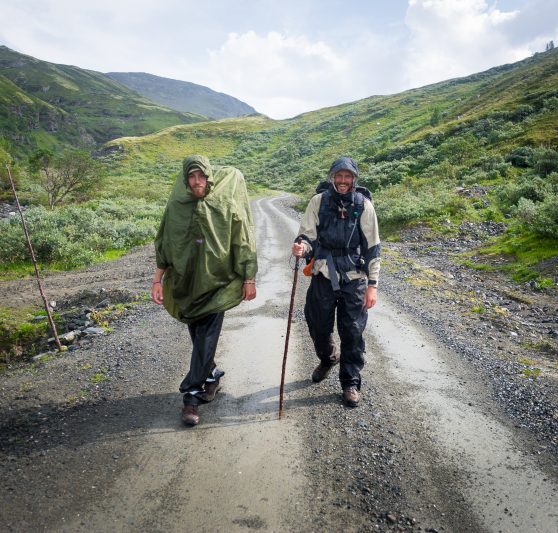
Clothes
The clothes you bring should cover a temperature range from 0 to 30 °C, and take into account that it might rain. A rain poncho covers you and your backpack, but is impractical in wind. A breathable rain jacket with a thin mesh lining will keep you dry, but remember a rain cover for the backpack. It's practical wiht rain pants that can be put on without removing the shoes. See our suggesed packing lists for sleeping indoors or outdoors on your pilgrimage.
Footwear
The pilgrim paths through Norway are mostly on footpaths, asphalt and dirt roads and do not require heavy footwear such as traditional mountain boots with rigid soles. But your hiking shoes or boots must be wide enough, not just long enough - you need to be able to spread your toes, and there must be room for your feet to swell a little.
The shoes must provide good support, have good flex in the forefoot so they do not tilt, and cushioning that facilitates walking on roads. In areas with a lot of asphalt, it is recommended to change to lighter footwear with good cushioning. If you have boots without cushioning, the use of soles in cushioning material can be helpful. Ankle high shoes are better in wet terrain. Some alternate between shoes, boots and sandals.
Learn about what surface you'll be walking on before the hike so you are well prepared.
Prevent foot blisters
Your shoes should be broken in before you start the hike. Good padding of the feet prevents rashes and moist problems. One or two pairs of thin wool socks is a proven piece of advice, because two thin pairs of socks dries faster than one thick pair. If possible, wash your socks daily.
Concider gaiters
Simple gaiters keep pebbles, debris and moisture out of the boots.
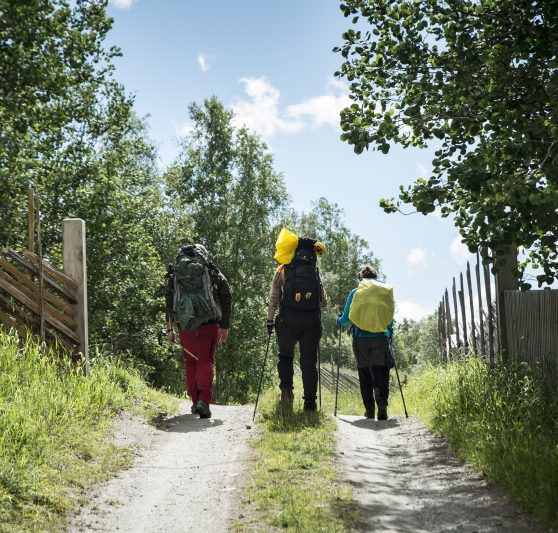
Backpack
Backpacks of 50-80 litres, with stiffened back, padded carrying belt, and chest strap are available in many variants. The backpack should have the right length for you so that the weight is evenly distributed between shoulders and hips. Simple bags without too many pockets and straps often weigh less. If you are able to pack less than 10 kg, it's less important to have a padded carrier belt. You can use packing bags to sort the contents.
Other equipment
It is recommended to bring a light sleeping bag of 0.5–1 kg with a zipper on the side, since some of the most basic accommodations do not include bed linen or wool blankets. In some accommodations you will also need a sleeping mat. This may also come in handy if you want to take a rest outdoors along the way.
We recommend a walking stick - or two. The backpack may disturb your balance, and the rod provides extra support. In steep areas it acts as a relief on the knees and your back. You can make one yourself, or buy a telescopic one. With rubber knob on the tip, it will make less noice.
Have a look at our suggested packing lists:


Maps
There are paper maps available for several of the Norwegian pilgrim trails.
Gudbrandsdalsleden
- Moelv to Fåvang. 1:50 000 Turkart Lillehammer 1:50.000 - Kart - Calazo.no
- Fåvang to Otta. 1:50 000 Turkart Ringebu & Venabygdsfjellet 1:50.000 - Calazo.no
- Otta to Hjerkinn. 1:50 000 https://www.calazo.no/no/kart/...
- Hjerkinn to Oppdal. 1:50 000 https://www.calazo.no/no/kart/...
- Hjerkinn-Oppdal 2. 1:50 000 https://www.kartbutikken.no/ca...
- Buvika-Trondheim/ Nidaroscathedral. 1:25 000 https://www.calazo.no/no/kart/...
St.Olavsleden.
- Hell/Ersgard to Nidarosdomen. 1:25 000 https://www.calazo.no/no/kart/...
Romboleden
- Skarvdörrsfjället to Selbustrand. 1:50 000 https://www.calazo.no/no/kart/...
- Selbustrand north to Trondheim/ Nidaroscathedral. 1:25 000 https://www.calazo.no/no/kart/...
Valldalsleden
- Valldal to Bjorli. 1:50 000 https://www.calazo.no/no/kart/...
Guidebooks
There are guidebooks for some of the trails in several languages. Please note that we cannot guarantee updated information in guidebooks, these may be out of date. You can find updated information on the digital map at pilegrimsleden.no
BOOKS IN ENGLISH
Hiking guide Gudbrandsdalsleden - The St. Olav way From Oslo to Trondheim.
Written by Ria Warmerdam.
Cycling guide Gudbrandsdalsleden - The St. Olav Way from Oslo to Trondheim.
Written by Gea Van Veen.
St. Olavsleden – a pilgrims path in northern Scandinavia
Written by Staffan Söderlund and Marie Sjöström.
Hiking guide Valldalsleden - An Olav's way from Valldal to Fokstugu and on to Trondheim.
Written by Ria Warmerdam.
BOOKS IN DUTCH
Wandelgids Het Olavspad - Gudbrandsdalsleden Noorwegen Van Oslo naar Trondheim.
Written by Ria Warmerdam.
Wandelgids St. Olavspad - S:t Olavsleden Zweden Van Selånger naar Trondheim.
Written by Ria Warmerdam.
Fietsgids St. Olavspad - St. Olavspad (Zweden-Noorwegen) Fietsroute van Selånger naar Trondheim
Written by Gea Van Veen.
BOOKS IN GERMAN
Olavsweg - Von Oslo über Mjøsasee und Dovrefjell nach Trondheim.
Written by Susanne and Walter Elsner, Bergverlag Rother (2023).
You can get it at Rother publisher or Oslo Pilgrim Center.
BOOKS IN NORWEGIAN
Pilegrimsleden fra Oslo til Trondheim - En praktisk guide til vandringen.
Written by Bjørn Ivar A. Voll and Ellen Rykkja Gilbert.
Tunsbergleden fra Larvik til Oslo - En praktisk guide til vandringen.
Written by Ellen Rykkja Gilbert.
Pilegrimsleden fra Dovre til Trondheim - en kulturhistorisk guide.
Written by Hans-Jacob Dahl.
You can get it at the visitor center at Nidaros Cathedral, or the pilgrim centers Dovre, Dale-Gudbrand, Hamar and Oslo. And several of the accommodations along the trail.
If you have suggestions for other books that should be on the list, feel free to contact the National Pilgrim Center of Norway.