Oppdal - Trondheim
Arrival Oppdal and recommended hiking period
There are bus and train connections to the startingpoint, Oppdal, from both north and south.
Train: Oppdal Station
Bus: Get off at Oppdal Bus Terminal
For tickets, see www.entur.no.
For bus and train schedules, see www.vy.no or www.sj.no.
In Oppdal town center you will find several supermarkets and sports shops. You will also pass supermarkets along the way in Meldal, Løkken, Skaun, and Buvika. In Løkken Verk there is also a sports shop.
Recommended hiking period: May 15 to September 30. Outside this period, check the weather forecast and whether accommodation providers are open.
On the day of arrival, why not take the time to familiarize yourself with Oppdal, visit Oppdal Church, and the Viking burial ground at Vang. They are both located 3 km west of the town center, along Pilegrimsleden.
Accommodation:
Day 1: Oppdal - Rennebuskogen (22,5 km)
From Oppdal town center, follow the markings toward Hovden / Gondolen to reach Gamle Kongeveg (The Old King’s Road), where Pilegrimsleden is marked northwards toward Stølen. The stage continues from Stølen along Eldste Kongeveg (the Oldest King’s Road) before rejoining the Gamle Kongevei, which you follow all the way to Rennebuskogen.
If you prefer a shorter first day than walking all the way to Rennebuskogen, you can stop at IMI Stølen (4 km from Oppdal), or continue to Fagerhaug, where both Oppdalporten and Stugguhaugen offer accommodation (12 km from Oppdal).
Accommodation:
Oppdal (north):
Rennebuskogen:
Day 2: Rennebuskogen - Stamnan (20 km)
From Rennebuskogen, follow Gamle Kongeveg toward Rennebu. The stage continues partly on roads and partly through forest and farmland. At Skjepphaugen there are two options; an easier route along the river Orkla, or to follow Pilegrimsleden uphill to Slipran and then continue along the old travel route through Rennebu, where there are several traces of St. Olav.
If you wish to walk further than Stamnan this day, you can continue on to Voll (+7 km). See the description under Day 3.
Accommodation:

Foto: Øyvind Wold
Day 3: Stamnan - Ry (14 km)
This stage begins with an ascent that offers stunning views, before you enter into agricultural landscapes and follow the path leading to the beautiful Rennebu Church and Gammelbua Pilgrim Information Centre. From the church there is about 100 km to Nidaros, and it is the last point where you can join the trail if you wish to qualify for the Olav Letter.
From here, the trail continues past old large farms and several traditional trønderlån (Trønderlag farmhouses). Along the way, you can stop at Ry farm, where there is a pilgrim café (licensed to serve alcohol) and also offers accommodation. Alternatively, you can continue on to Segard Hoel, which also provides both lodging and meals.
Accommodation along the stage:

Dag 4: Ry - Meldal (18 km)
This is a varied stage with many cultural heritage sites, churches, and old farms located close to the trail. Before reaching Meldal, you will experience Jorlia, a thousand-year-old farm with a distinctive farmyard. In Meldal, the Parsonage Garden is well worth a visit. Meldal Village Museum offers an insight into 17th-century local history, and there is an overall wealth of historical sites to explore along this stage if you have the time.
Both Meldal and Løkken Verk are small towns with shops, and there are several accommodation options to choose from along the way.
Accommodation along the stage:
Day 5: Meldal - Gumdalen (20km)
There is much to experience along this stage, including several cultural heritage sites close to the trail. Gammelgruva in Løkken Verk offers local mining history from the 17th-century , and you will also pass Svorkmo smelting hut.
Further along you can catch a old museum train from Løkken to Svorkmo with the old Thamshavn Railway that operates three days a week from the end of June to mid August. In other words, there is a fair amount of history to explore on this stage, if you are curious. Before arriving in Gumdalen, you'll come through Løkken Verk - a small village with a supermarket.
Accommodation on this stage:
Day 6: Gumdalen - Skaun (20 km)
The trail towards Skaun passes through evergreen forest and across green grazing fields, following well-maintained trails. The beautiful lake, Solsjøen, offers a particularly idyllic scenery. About halfway through the stage, you will pass through an area of marshy ground, where your feet may get a little wet. After this section, the trail returns to firm paths and roads that lead you onward to Skaun.
In Skaun, you’ll find the impressive Skaun Church - a medieval stone church dating from around 1180, believed to have been built by the same stonemasons who worked on the octagon of Nidaros Cathedral.
Accommodation options:

Photo: Karl Inge Jensen
Day 7: Skaun - Øysand (16 km)
The second-to-last stage on the way to Nidaros Cathedral passes largely through farmland, in the historic landscape made famous by writer Sigrid Undset’s Kristin Lavransdatter. Pilgrimage plays an important role in these novels, and Undset chose Husaby farm, just beyond Skaun, to be the setting for the second book, "Husfrue".
At the beginning of this stage, you’ll enjoy views over the landscape behind you that you have already walked through. Toward the end of the stage, the route opens up to sweeping views of the river delta where the Gaula River meets the Trondheimsfjord. You are approaching your final destination!
If you wish, you can shorten the day’s walk by staying overnight at Belsås Farm and adding an extra day to your journey. This would allow you to avoid a particularly long final stage from Øysand to Trondheim.
Accommodation options:
- Belsås Farm (approx. 9 km before Øysand)
- Strandheimen Pilgrim Accommodation
- Øysand Camping
- The Stabbur at Skjefstad (approx. 8 km after Øysand)

Day 8: Øysand - Trondheim (25 km)
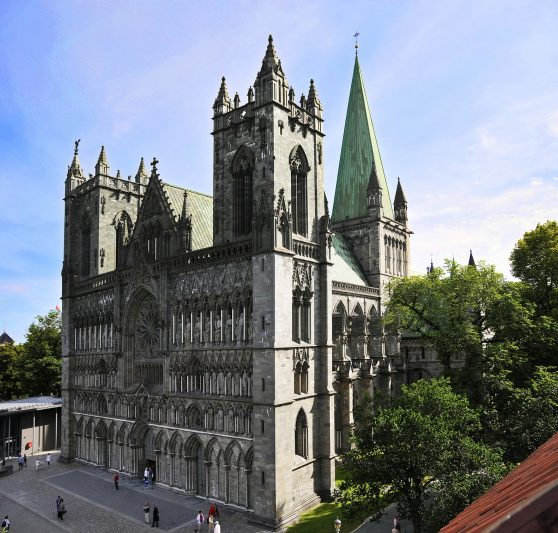
This final stage leads through lush cultural and agricultural landscapes in the outskirts of Trondheim, continuing through the very popular forest area, Bymarka, and down through the neighborhoods of Byåsen and Sverresborg. Along the way, you pass an old farmstead, the well-known Kongesteinen (King’s Stone), and attractions such as Granåsen Ski Centre and Sverresborg Trøndelag Folk Museum, before finally reaching your final destination: Nidaros Cathedral.
Along the way, you pass Stabburet at Skjefstad and Lian Gård Pilgrim Hostel, both good accommodation options if you prefer to split the day in two.
At the Pilgrim Reception close to Nidaros Cathedral in Trondheim, you can receive the Olav Letter, collect the final stamps in your pilgrim passport, be registered in the pilgrimage statistics, and obtain free access to Nidaros Cathedral.
Accommodation in Trondheim:
- Lian Gård (approx. 8 km before Trondheim)

Foto: kirken.no


Foto: Øystein Moe/Helmet
Our digital trip planner
A map with overview of all accommodation options and more information can be found in our pilgrimage planner.
Experiences along this route
-
Church
Oppdal Church
Gudbrandsdalsleden -
Cultural Heritage
Vangfeltet
Gudbrandsdalsleden -
Outdoor shelter
Guriberget
Gudbrandsdalsleden -
Rest stop
Pilgrim bench Stavåa
Gudbrandsdalsleden -
Accommodation
Hæverstølen
Gudbrandsdalsleden -
Rest stop
Pilgrim bench Eggan - Slipran
Gudbrandsdalsleden -
Cultural Heritage
St. Olavskleiva
Gudbrandsdalsleden -
Cultural Heritage
Gammelbua - information point for pilgrims
Gudbrandsdalsleden -
Church
Rennebu Church
Gudbrandsdalsleden -
Accommodation
Ry Hostel and Guest House
Gudbrandsdalsleden -
Cultural Heritage
Jorlia
Gudbrandsdalsleden -
Rest stop
The Parsonage Garden in Meldal
Gudbrandsdalsleden -
Cultural Heritage
Meldal Parsonage
Gudbrandsdalsleden -
Church
Meldal Church
Gudbrandsdalsleden -
Cultural Heritage
Meldal Village Museum
Gudbrandsdalsleden -
Accommodation
Olskastet Sælehus
Gudbrandsdalsleden -
Transport
Thamshavnbanen
Gudbrandsdalsleden -
Cultural Heritage
Løkken Verk
Gudbrandsdalsleden -
Cultural Heritage
Svorkmo Smelting Works
Gudbrandsdalsleden -
Church
Skaun Church
Gudbrandsdalsleden -
Accommodation
Lian Gård - Pilgrim Hostel
Gudbrandsdalsleden -
Accommodation
Kleivan
Gudbrandsdalsleden -
Accommodation
Lerfald gård
Gudbrandsdalsleden -
Accommodation
Konstadtunet
Gudbrandsdalsleden
Useful reading
Nidaros Cathedral
Friends on a pilgrimage

Packing list
Routes nearby
[[ notice ]]
We found no trail suggestions.
Try to filter on something else.